Beyond the MVP: A Founder’s Blueprint for Building a Production-Ready V1
14 min read
Congratulations are in order. You built the MVP, proved that there was something worth building, and raised capital on the strength of that validation. Then the clock starts ticking. If you now have roughly twelve months to turn that MVP into a stable, scalable V1, you are no longer trying to prove that the idea works. You are trying to build something that thousands of professional users can rely on when the work they are doing actually matters. That is a very different challenge. An MVP can get away with shortcuts. It can have rough edges, manual processes, fragile integrations, and architecture that was designed around getting to the next demo. A production system used by experts cannot rely on the same assumptions. It needs to be reliable under pressure, secure enough for institutional use, observable when things go wrong, and structured in a way that can support the product you are actually trying to become. There is no single path from MVP to V1, though. The approach in this article is designed for the kind of startups that are building for expert users in a high-stakes or regulated environment, selling into organisations with real procurement and security requirements, with roughly twelve months of funded runway, and with AI playing a meaningful role in the product. If you are building a low-stakes consumer app, you probably do not need all of this machinery. In fact, applying this approach too literally could slow you down and create complexity you do not need. Take the mental models, not necessarily the architecture. Even within the profile described here, this is not a recipe to follow step by step. The sequence matters, but the emphasis will change depending on your domain, the consequences of failure, how regulated the product is, how deeply AI sits in the critical path, and how you sell. A healthcare product with AI making clinical recommendations will have very different requirements from an enterprise analytics platform, even if both have expert users and institutional buyers. A product sold bottom-up will also have a different path to adoption from one that requires a lengthy, top-down procurement process. The useful question is therefore not, “What is the universal way to build a V1?” It is, “Given the product we are building and the environment it has to operate in, what needs to be true at each stage before we move to the next?” That is the framework we will use here. Over the next twelve months, we will move through the problem phase by phase: understanding what is worth carrying forward from the MVP, finding the right wedge, establishing the architecture, hardening the system, keeping experts in the loop, validating resilience, and gradually introducing the product into real production environments. The goal is not simply to ship a bigger MVP. It is to make the transition from something that proves the idea to something an institution can safely depend on.
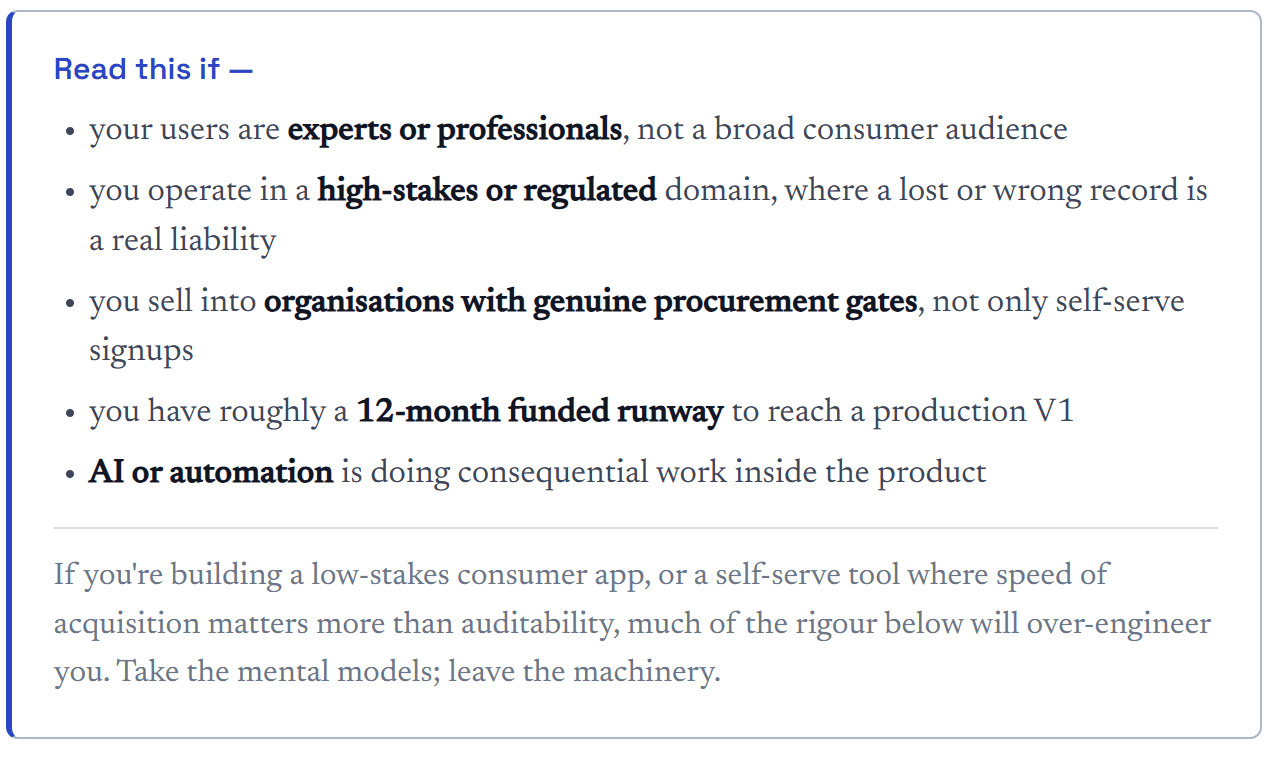
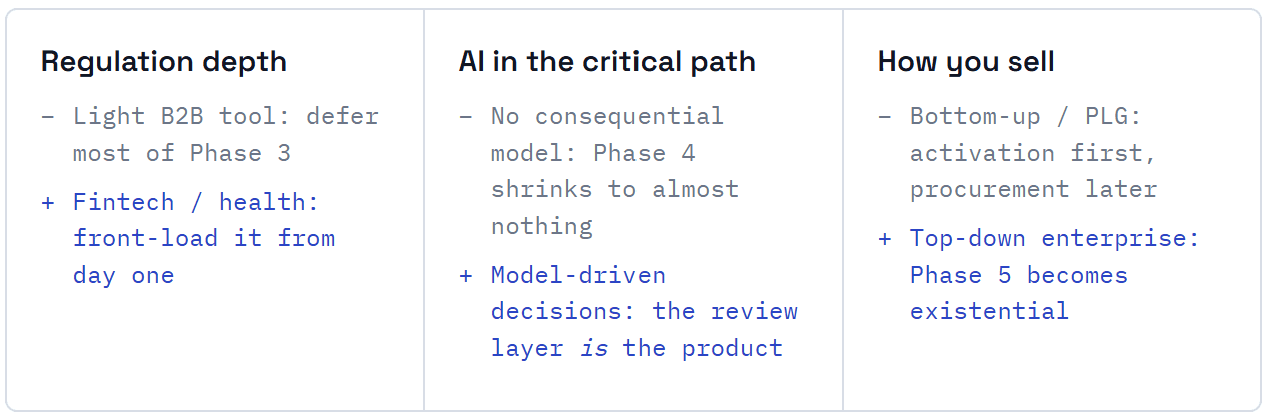
And even inside that profile, this is a system to tune, not a recipe to follow. What stays constant across every version is the sequence: audit, wedge, harden, keep the expert in the loop, prove resilience, then ramp. What changes is the weight you give each phase. Three dials set that weight:
The MVP Got You Here. V1 Has a Different Standard
Before we walk the timeline, we have to agree on what ready means because it is about to shift.
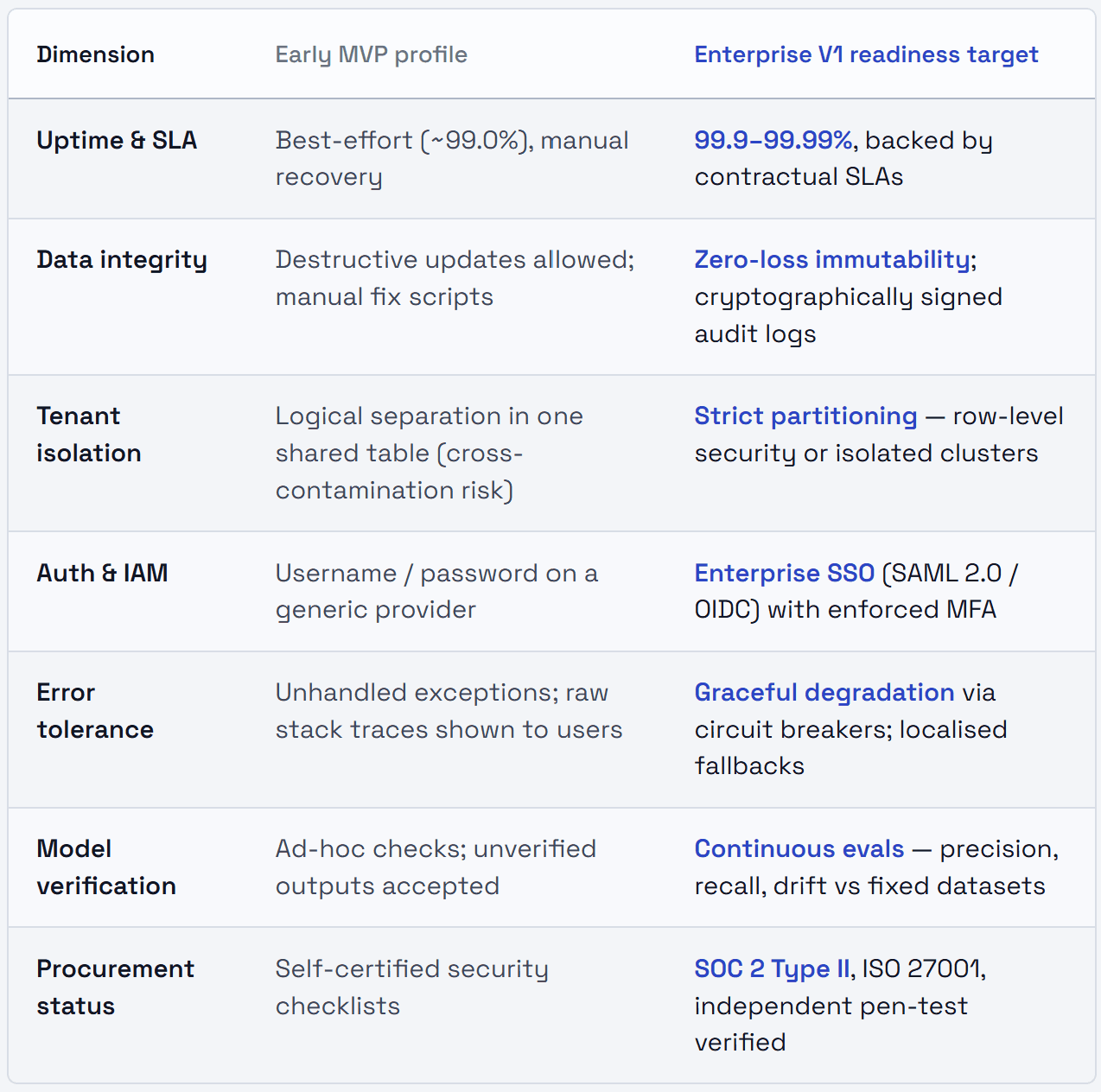
The metrics that won you an MVP are not the metrics that close an enterprise sale. Early on, you optimise for evidence of traction: users, activation, the shape of the demand curve. From here forward, the scoreboard becomes precision, deterministic behaviour, and structural reliability. Growth still matters, it just stops being the thing that gets you through a procurement review.
Here is the shift, dimension by dimension. If you internalise one artefact from this piece, make it this table. Every phase that follows exists to move a row from the left column to the right.
Phase 1 : Structural Audit & the Core-vs-Utility Isolation
Early MVPs are built to demonstrate a thesis. That is their job, and it is why they are so often held together with fragile configuration and loose architectural decisions that made perfect sense when the only goal was a convincing demo. The natural instinct at this point is to keep layering on top of what you already have and bolt the V1 features onto the existing mvp. But in a high-stakes environment, that can end up being one of the most expensive mistakes you make.
So the first 30 to 60 days are not really about building. They are about understanding what you have, what you can trust, and where the risks are.
I call this Core-vs-Utility isolation.
The System Core is the proprietary logic and data model that gives the product its value, the parts that represent your actual intellectual property and competitive advantage. Utility is everything around it: authentication, data transport, storage, generic analytics, and other infrastructure that is important but not inherently unique to your product. These are hard problems, but they are also problems that other companies have already solved, often better than you could in the next twelve months. The goal of the audit is to draw that line clearly, because we should treat these two sides very differently.
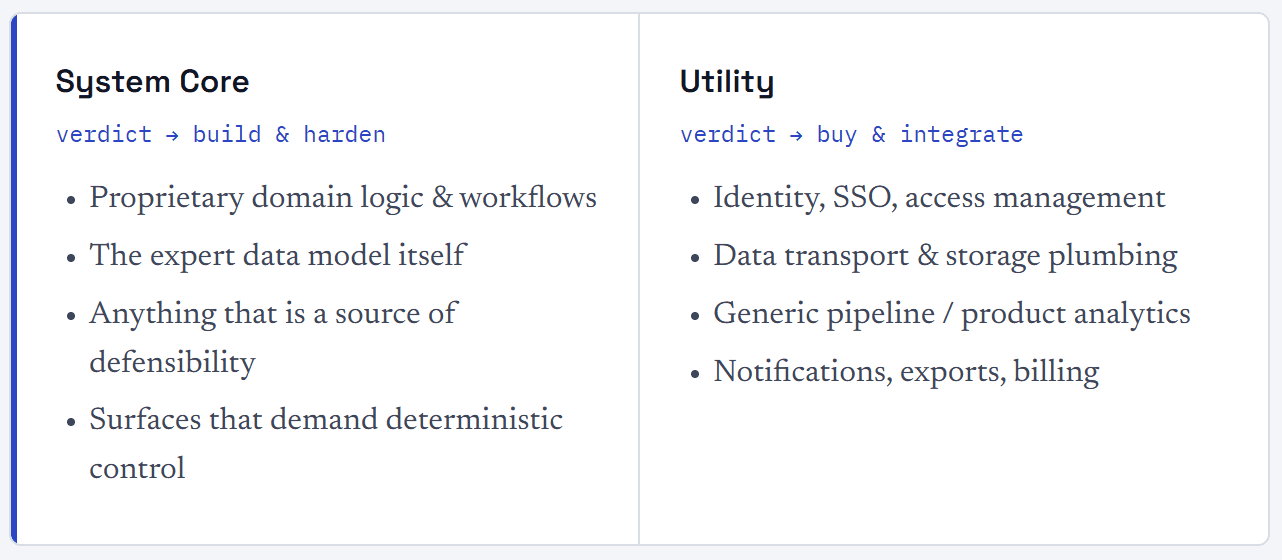
This audit also answers the question you are probably dreading: do we need to rebuild? Here is my honest rule.
The rebuild trigger. If the audit shows that the existing codebase cannot give us deterministic control, meaning we cannot predict exactly how data moves through the system or how it behaves when something fails, we do not patch around the problem. We rebuild the architecture from the ground up.
That approach might sound drastic, and founders often resist it because the current MVP “works.” But trying to patch a fragile data schema while moving toward an enterprise deployment does not just cost you a little speed. The cost compounds every month, and eventually, you can end up moving an order of magnitude slower. The better approach is to isolate the baseline IP, the System Core, and rebuild clean interfaces around it. You keep what is valuable and stop carrying the scaffolding forward.
There is one more thing to consider, because timing matters. A rebuild decided in month one is a good move. But the same rebuild is forced on month eight, halfway through procurement, it can become a crisis. That is exactly why the audit has to come first.
Phase 2: The Wedge Strategy & Architecture Isolation
Once the audit is complete and you have a clear line between the System Core and everything else. Now, you have cleaned up the foundation, and it feels like the right time to build the full vision: all the workflows, all the features, and the entire platform you originally pitched. Do you? I think that is exactly where teams can lose focus.
When you have twelve months, a small team, and users or investors who expect the product to work reliably from day one, trying to build the entire platform at once is a good way to end up with a product that does many things reasonably well but does not solve any one problem particularly well. The better approach is to find the narrowest point of entry where the product can create meaningful value quickly.
I call this the Wedge Strategy.
The idea here is to launch a highly focused V1 that solves one acute operational problem promised in the product's value proposition exceptionally well. It should be a problem your users encounter frequently, one that is painful enough that solving it properly changes their day-to-day workflow. You are not trying to build the entire platform on day one. You are trying to earn adoption by becoming indispensable for one important job.
The important part is what happens underneath that focused experience. The V1 may release only one workflow, but the underlying data model should be designed with the larger product in mind. You can keep the first release narrow while still modelling the entities, relationships, permissions, and audit requirements in a way that does not paint you into a corner later. The wedge is what users see first. The data model is where you preserve the ambition of the broader platform.
That distinction matters because the easiest shortcut to take during an MVP is often the one that creates the most expensive migration problem later. If you structure the first version around the immediate feature rather than the underlying domain, you may eventually have to move customers, rewrite integrations, or change how critical data is stored just to support the next stage of the product. The goal is that the users should adopt you because you solve one thing completely well, while the architecture quietly gives you room to expand from that one workflow into a much broader operating system for their work.
Architecturally, the way I'd hold both — speed now, scale later — is a Modular Monolith. It gives you the deployment simplicity of a single codebase, which is what you want when the team is small and the clock is loud, while enforcing absolute data isolation between modules on the inside. You get to structure and store expert data cleanly today, in a shape that scales into an end-to-end system tomorrow, without paying the operational tax of microservices before you can afford it. I am saying this from experience, but if you have an architect on your team, it’s ultimately their call.
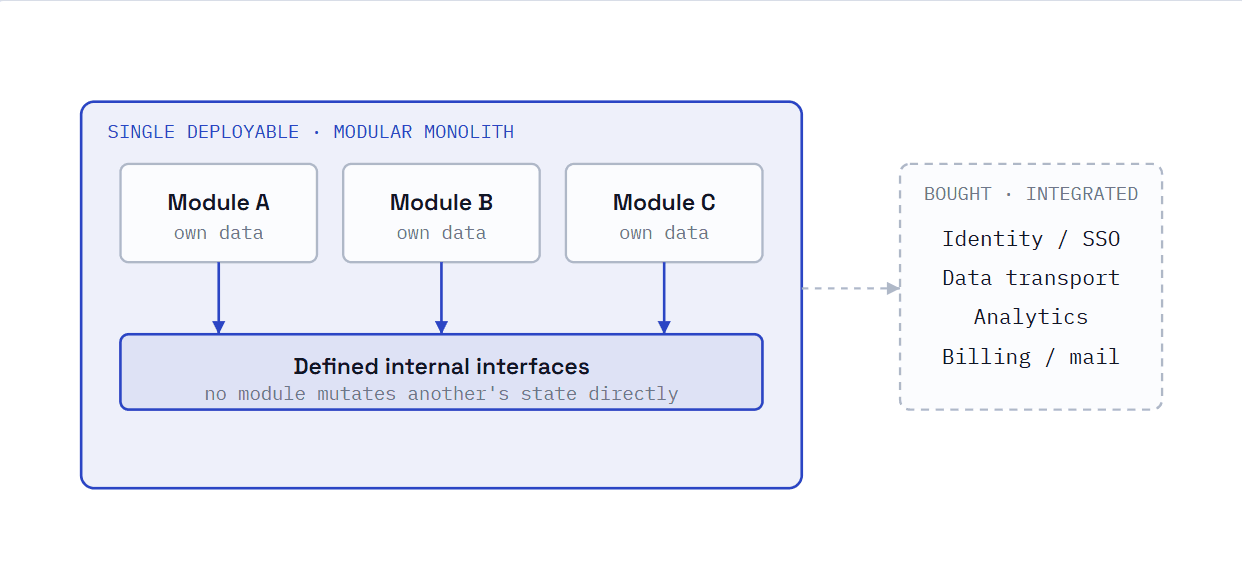
In my opinion, a modular monolith gives a small team the operational simplicity of a single deployable application without forcing everything into one undifferentiated codebase. The team can move quickly, deploy without managing a distributed system, and debug problems without tracing requests across a dozen services. At the same time, the application is deliberately divided into well-defined modules, with clear ownership of data and responsibilities.
Two principles make that approach work:
Rigid interface boundaries
Modules never reach into each other's data and mutate it directly. They communicate only through clearly defined internal interfaces. This is what lets you extract a module into its own service years later without unpicking the whole system — the seams are drawn now, while they are cheap to draw. If the Billing module needs information from the Patient module, for example, it should request that information through a defined interface rather than querying and modifying the Patient module's data directly.
This discipline can feel unnecessary when the team is small. In the beginning, it is often faster to bypass the boundary and access the data directly. The problem is that these shortcuts accumulate. A year later, you no longer have clear ownership of the data, and extracting one part of the system becomes a risky exercise in discovering which seemingly unrelated parts of the application depend on it. With explicit interfaces, the seams are established early, when they are inexpensive to establish. If a module eventually needs to become an independent service, you already know where its responsibilities begin and end. The extraction becomes an architectural evolution rather than a rewrite.
Offload the non-strategic heavy lifting
The other principle is knowing what not to build. We should not spend engineering time building our own authentication system, data transport layer, generic analytics infrastructure, or other commodity capabilities unless there is a specific reason they are part of our competitive advantage. These are important pieces of the product, particularly in an enterprise environment, but importance does not mean we need to build it ourselves.
If another company already provides mature, enterprise-grade infrastructure that meets our security, compliance, reliability, and integration requirements, using it can be the more responsible product decision. It reduces the amount of infrastructure we have to maintain and, more importantly, keeps the engineering team focused on the part of the system that actually differentiates us. Every hour spent reinventing commodity infrastructure is an hour that cannot be spent improving the System Core, refining the domain model, understanding expert workflows, or solving the operational problem that brought customers to the product in the first place.
The objective is not to outsource everything around the product. It is to be deliberate about where we invest our engineering effort. We build deeply where the product needs to be differentiated, and we integrate proven infrastructure everywhere else.
That is how the wedge strategy and architecture isolation work together: keep the user experience narrow enough to ship something exceptional, keep the underlying model broad enough to support where the product is going, and keep the architecture disciplined enough that growth does not force you to rebuild what you already shipped.
Phase 3: Infrastructure Hardening: Access, Sovereignty & Immutability
In an institutional environment, proving who touched data, where that data physically lives, and how the system arrived at its current state is as important as the logic itself. It is what a SOC 2 Type II, ISO 27001, or a sector mandate like HIPAA, GDPR, or BCBS 239 actually examines. The exact requirements vary by framework and industry, but the underlying expectation is similar: you need to be able to demonstrate control rather than simply claim that you have it. That is why we should not treat security, auditability, and data residency as things we add after the product is built. They need to be part of the architecture from the beginning.
Three areas do most of the heavy lifting:
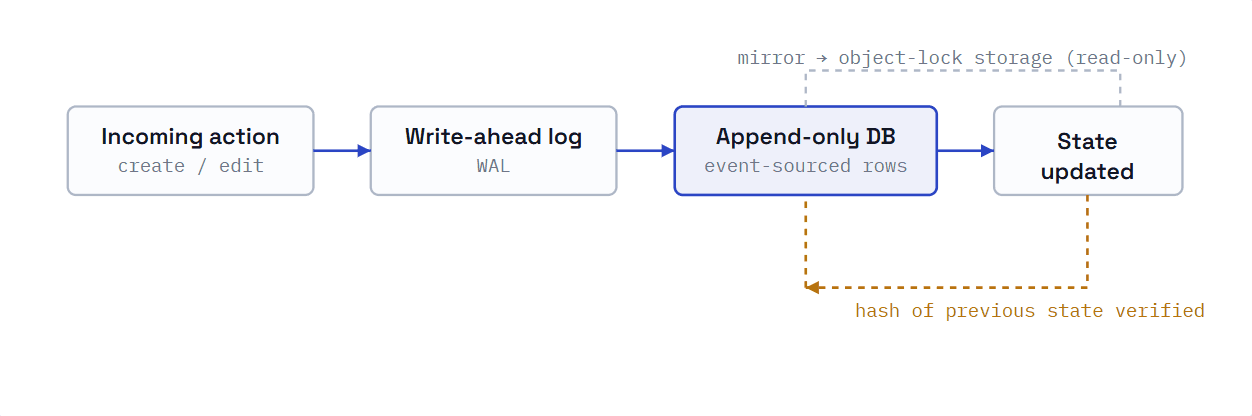
Cryptographic, append-only auditing
On the tables that matter, we block direct UPDATE and DELETE outright. Every change is modelled as an event — an append. When an user edits a record, the system writes a new state-mutation row carrying the user ID, a timestamped context, and a cryptographic hash of the previous state, chaining each change to the one before it. Those write-ahead logs are mirrored to read-only storage with object-lock immutability, so even a full infrastructure breach cannot retroactively rewrite history. You can always answer "what did this record look like at 3pm on the 14th, and who changed it?" with proof. That distinction becomes particularly important when the system is handling decisions, records, or workflows that may need to be reviewed months or years later.
Granular access governance
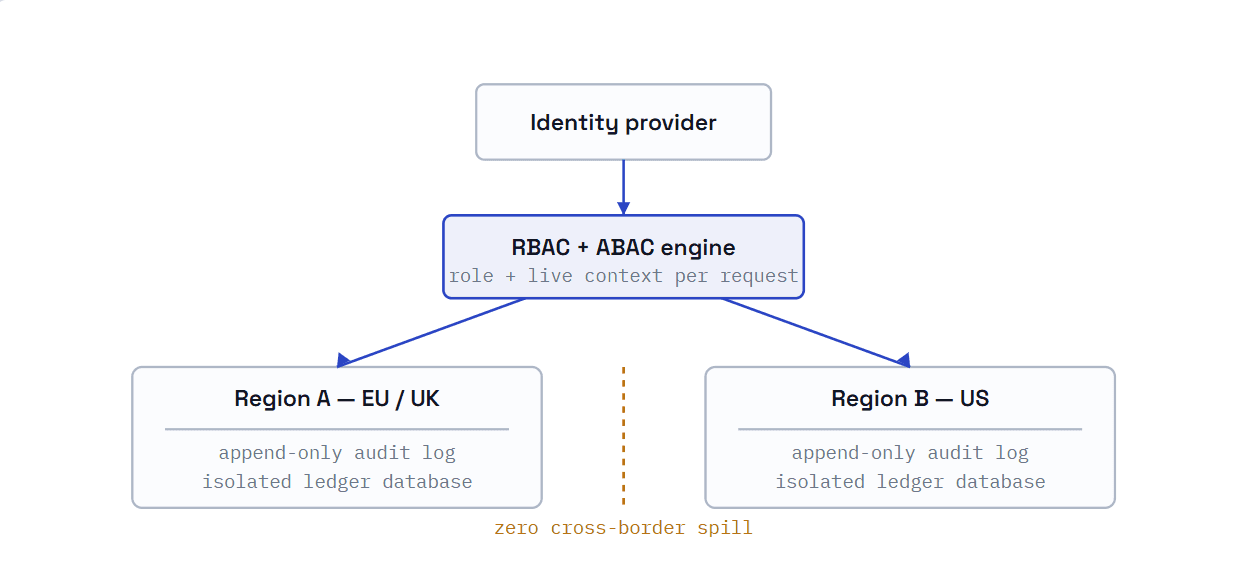
Enterprise access control also has to go beyond a simple question of whether someone can or cannot access something. A user's role is only making one part of the decision. A user who is the lead auditor and another user who is a specialist consultant may have different responsibilities, but their access may also depend on which organization they belong to, which workspace they are operating in, which tenant owns the data, or which network and geographic boundaries apply to the request.
This is where a combination of Role-Based Access Control (RBAC) and Attribute-Based Access Control (ABAC) becomes useful. Instead of putting all of the access logic into a static permission table, the system evaluates the user's role together with the context of the request. The result is a much more granular model of access: a user gets access to the specific data and actions required for the task, within the boundaries that apply to that particular request.
The principle is simple: access should be as broad as necessary to do the job, but no broader.
That also makes access easier to reason about and audit. When an enterprise customer asks why someone had access to a particular record, we should be able to explain not only who the user was, but why the system allowed that request at that point in time.
Data sovereignty & multi-region containment
Data residency becomes another architectural concern once you start working with enterprise customers across different countries and regulatory environments. Some customers will require their data to remain within a particular country or geographic region. In those cases, simply promising that data will stay local is not enough. The architecture needs to make that boundary enforceable. One way to do this is to separate the application and data planes. The stateless application layer can be deployed globally, while customer data is partitioned into region-specific data planes. Requests are then routed to the appropriate database and storage systems based on the customer's tenancy and residency requirements.
The important part is that the boundary applies to more than the primary database. Backups, audit records, operational logs, analytics pipelines, and other systems that might contain sensitive information need to respect the same regional constraints. The goal is to make data residency a property of the system itself rather than something maintained through operational promises and contractual language.
That is the broader principle behind infrastructure hardening: the controls that matter most should be enforced by architecture wherever possible. If access needs to be restricted, the system should enforce it. If historical records need to be immutable, the storage layer should help enforce that. If customer data cannot cross a regional boundary, the architecture should make that boundary explicit. The more of these guarantees we can make structurally, the less we have to rely on people remembering to do the right thing later.
Phase 4: Designing for Failure Modes: The High-Leverage Review
At this point, the foundation is in place. The next challenge is what happens when we start putting intelligence on top of it. This is where many teams building with machine learning or LLMs make an important mistake: they try to automate the entire workflow too early. In a high-stakes environment, that can quickly become an operational trap. The end users of these systems are already experts in their niche. Their judgment is the valuable part of the workflow. The product does not need to replace that judgment; it needs to remove the repetitive work around it, surface the information they need at the right moment, and help them reach a decision faster and with more confidence.
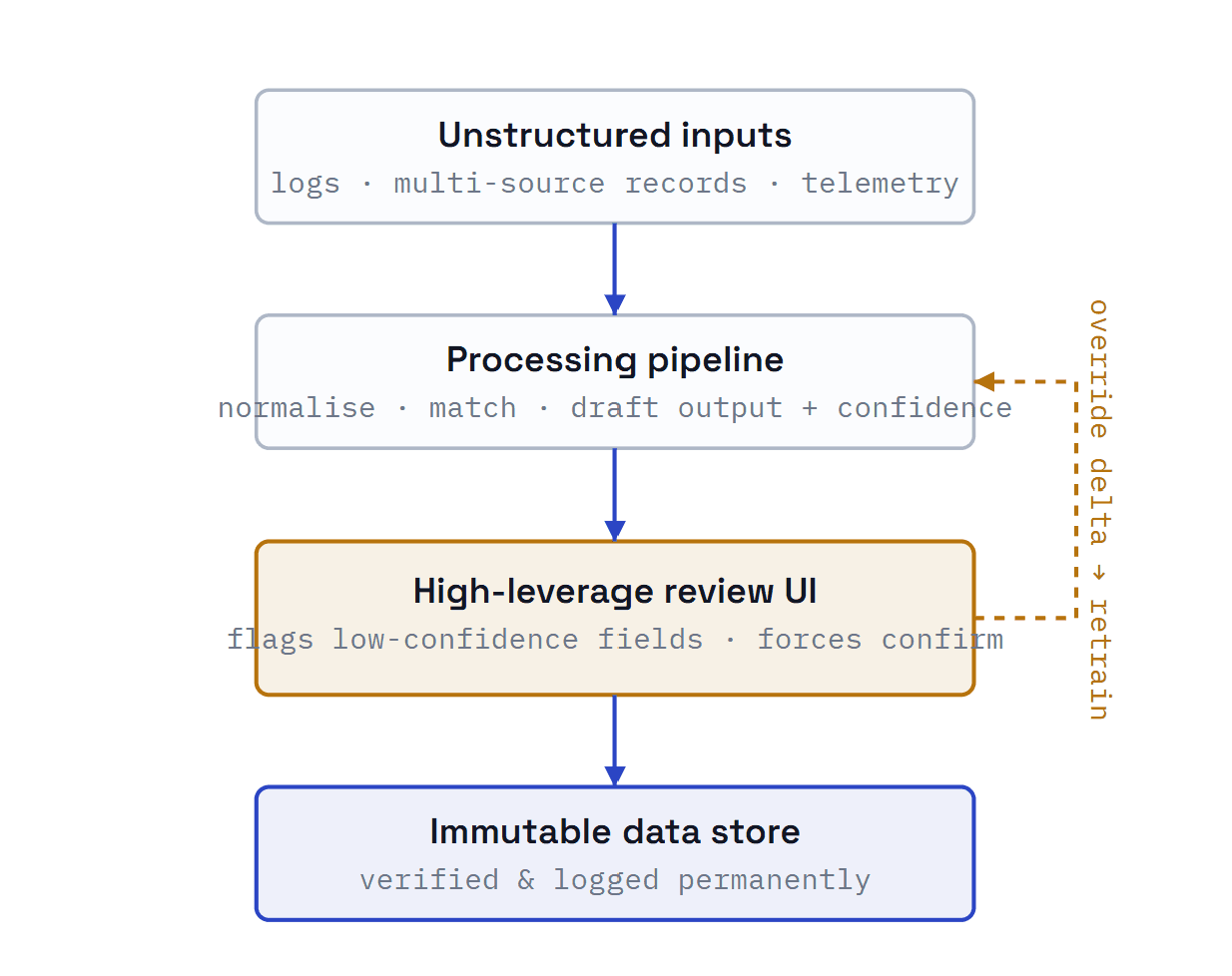
That changes how we should think about V1. Instead of building an autopilot, the intelligence layer should be designed as a high-leverage review experience. Whether the product is helping with diagnosis, monitoring a complex system, reviewing documents, or surfacing potential issues or business insights, the underlying principle is the same: reduce the expert's cognitive load while keeping the human decision at the centre of the workflow. The system should do as much of the work as it can reliably do. When it reaches the edge of its confidence, it should make that uncertainty visible and bring the expert into the loop.
Two mechanisms are particularly important here:
Confidence scoring and a dynamic interface
Every automated output should carry some indication of how confident the system is in that result, with thresholds defined according to the task and the consequences of getting it wrong. For example, a high-confidence classification might move through the workflow automatically, while an ambiguous result could be flagged for review. The exact threshold should not be treated as a universal number; a 95% confidence level may be appropriate for one task and completely insufficient for another. What matters is that the system knows where its uncertainty matters and that the interface responds accordingly.
When an output falls below the appropriate threshold, the UI should change rather than treating the result like any other. The uncertain field might be highlighted, the underlying evidence might be surfaced, or the system might require an explicit human confirmation before the workflow can continue. The principle here is simple: certainty should stay out of the expert's way; uncertainty should attract their attention. A good review interface therefore does not ask an expert user to inspect everything. It directs their limited attention toward the parts of the workflow where their judgment actually adds value.
Explicit discrepancy auditing
The second mechanism is what happens when the expert disagrees with the system. We should not treat an override as a simple correction and move on. We should capture the difference between what the system proposed and what the expert ultimately decided, along with the context needed to understand why the discrepancy occurred.
That difference, or delta, can become some of the most valuable feedback data in the product. It tells us where the model is systematically getting things wrong, which cases are ambiguous, and where the workflow itself may need to change. Over time, those corrections can feed back into model evaluation, prompt or rule improvements, training datasets, and product design. The review interface therefore becomes more than a safety mechanism. It becomes a learning loop.
The product gets better because experts use it, and the experts gradually have less work to do because the system learns from the places where they had to intervene. That is the right relationship between automation and expertise in a high-stakes system. The goal is not to eliminate the human from the loop. It is to make the human dramatically more effective when their judgment is needed.
Phase 5: Institutional Validation and Procurement Readiness
By month nine, the scope should be largely locked. At this point, the feature debate is mostly over. The question is no longer, “What else can we add?” It becomes, “Can an institution trust this system enough to put it into production?”
That changes how the engineering team's time gets spent. Instead of continuing to expand the product, the team shifts toward proving that what already exists is reliable, secure, and resilient under the conditions it will actually face. That means hardening the infrastructure, running penetration tests, testing failure scenarios, validating performance under load, and building the evidence that security and procurement teams will eventually ask for.
Enterprise buyers are not evaluating a product purely on its feature list. They are also evaluating the risk of adopting it. They need to understand what happens when something fails, how the system protects their data, what controls are in place, and whether there is enough evidence behind the claims you are making.
Two areas become particularly important at this stage:
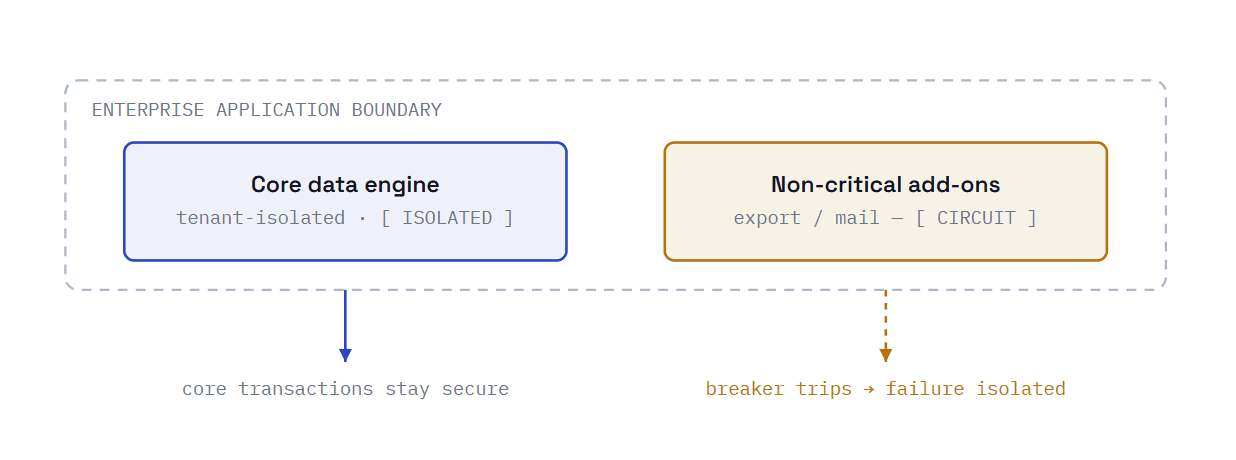
Structural resilience through circuit breakers
A reliable system should not allow a failure in one dependency to take down everything around it. Every non-core service and important third-party dependency should therefore have a defined failure boundary. Circuit breakers are one way to create that boundary. They can be implemented through infrastructure such as a service mesh like Envoy or through resilience libraries such as Resilience4j, depending on the architecture.
Imagine the "reporting service" suddenly becomes slow, or an external email provider starts timing out. Without isolation, those failures can cascade through the application. Requests pile up, resources get consumed, and eventually a problem in a peripheral service becomes an outage for the core product. With a circuit breaker approach in place, the system can detect that a dependency is failing and temporarily stop sending requests to it. The affected functionality can degrade or become temporarily unavailable while the core workflows continue to operate.
That is what graceful degradation should mean in practice. Not every part of the system has to be available all the time for the entire product to remain useful. The goal is to make sure that a bad day for a dependency does not automatically become a bad day for your customers.
Automated assurance artefacts
The other shift at this stage is from saying that the system is reliable to being able to demonstrate it. Enterprise and regulated buyers often need evidence they can review as part of their security and procurement processes. That means the team should be generating useful assurance artefacts continuously rather than trying to assemble everything when a major customer finally asks for it. Automated load tests can simulate significant traffic increases and capture the resulting performance and execution data. Security testing can produce documented findings and remediation records. Access reviews, audit logs, infrastructure configurations, and other relevant controls can be captured and maintained as part of the normal engineering process.
The same principle applies to external assurance. If SOC 2 or ISO 27001 is relevant to the customers you are targeting, the work toward those frameworks should begin early enough that the necessary controls and evidence are already part of how the company operates. An independent penetration test and clear documentation of how identified issues were addressed can then become part of the evidence package presented during procurement. This changes the procurement conversation in an important way. Instead of scrambling to answer every security question after a customer has already decided they want to buy, you arrive with the evidence already organized. The security questionnaire becomes a structured review of controls you have been operating all along, rather than an emergency project that suddenly lands on the engineering team's desk.
That is what procurement readiness really means: not having every possible certification or document on day one, but building the product and the organisation in a way that makes proving trust a natural part of the process.
Phase 6: Risk-Mitigated Deployment: The Dark Launch
For a platform like this, a traditional public “grand launch” creates the wrong kind of risk. A big launch puts every unknown into the same moment and exposes those unknowns to the exact customers whose trust matters most. Instead, the rollout should be deliberately uneventful.
We start with a dark launch, gradually introducing real production traffic and increasing the load in controlled stages. Each stage gives the team an opportunity to observe how the system behaves, identify problems, make adjustments, and then decide whether it is ready for the next step. This approach gives us something a traditional launch cannot: the ability to learn under real production conditions without putting the entire customer base at risk. We can validate performance, check that data remains consistent as traffic increases, understand how tenant provisioning behaves at scale, and uncover operational problems that may never appear in a staging environment.
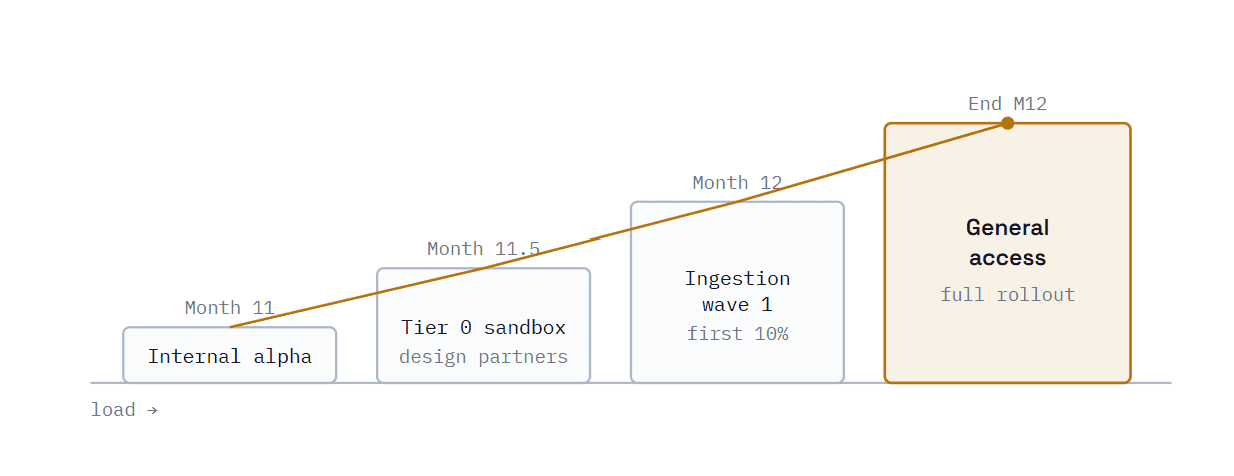
Two capabilities make that gradual ramp possible.
Dynamic feature flagging
Major product paths should sit behind server-side feature flags, particularly during the early stages of a production rollout. This gives the team control over who sees a feature, how quickly it is introduced, and how easily it can be disabled if something goes wrong. If a new workflow starts behaving unexpectedly, we should be able to turn it off without waiting for another deployment. If an issue is isolated to a particular tenant or customer configuration, we should be able to contain it without taking the entire feature offline.
That changes the nature of a production incident. Instead of needing to immediately deploy a code change under pressure, the team can often reduce the blast radius through configuration while investigating the underlying problem. The objective is not to use feature flags as a permanent substitute for good engineering. They are a safety mechanism that gives the team more control while the system is still being proven in production.
End-to-end tracing and observability
The other requirement is knowing what is actually happening inside the system when something goes wrong. Monitoring a few high-level metrics is not enough for a complex, multi-tenant platform. When an alert fires, the team needs to be able to follow a request through the system and understand where it slowed down, failed, or produced an unexpected result.
With distributed tracing, tools such as OpenTelemetry can attach a unique trace ID to a transaction and carry that context across the different components involved in processing it. An engineer can then move from a high-level alert down through the application, API boundaries, external dependencies, and database operations to identify where the problem originated. That can turn an investigation that might otherwise take hours into something much more targeted. The larger principle is that we should not treat launch as the moment when we finally find out whether the system works. Production should become another controlled environment for learning. We increase the load gradually, observe what the system does under real conditions, and expand the rollout only as the evidence gives us confidence to do so.
The Strategic Path Forward
There is no universal twelve-month playbook for taking an MVP to production. The right approach depends on what you are building, who will use it, what happens when it fails, and what your customers need to trust before they will put it into their workflows.
The approach described here is particularly relevant when those conditions are demanding: you are building for expert users, the product sits inside a consequential workflow, the data is sensitive, the cost of failure is high, or enterprise and regulated buyers will need to evaluate the system before they adopt it. It is also relevant when you have already validated the underlying product thesis and are now moving from “Can we build this?” to “Can an institution safely depend on this?”
That context matters. A consumer product with millions of potential users may need to optimise for distribution, experimentation, growth loops, and speed of iteration. A developer tool may prioritise integrations and ecosystem adoption. An internal enterprise application may have a very different tolerance for architectural complexity because the users, data, and infrastructure are already controlled within one organisation. And a research-heavy product may need to spend far more time validating the underlying technology before any of these delivery decisions make sense.
Even within high-stakes products, the right choices will vary. A healthcare platform, a financial system, an industrial monitoring product, and an enterprise compliance tool may all require strong auditability and access controls, but their regulatory requirements, failure modes, data models, and user workflows will be very different. The architecture should respond to those realities rather than forcing every product into the same template.
So I would not treat the principles in this article as a checklist to follow mechanically. Think of them as a way to sequence the decisions that matter when you are moving an expert-facing, high-stakes product from a validated MVP toward institutional adoption.
Audit before you build, so you understand which parts of the MVP are worth carrying forward. Wedge before you platform, so the first release solves a meaningful problem rather than trying to deliver the entire vision at once. Harden as you build, rather than discovering security, resilience, and compliance gaps at the end. Keep the expert in the loop where human judgment is part of the value of the product. Prove resilience before a customer has to ask whether the system can withstand failure. And ramp into production rather than treating launch day as the first real test.
The details will change from product to product. The underlying idea is more consistent: sequence the work so that each stage removes a meaningful category of risk before you take on the next one.
If you are starting from the position described at the beginning of this article, with a validated MVP, enough capital to execute, a defined market, and roughly twelve months to reach production, this is the framework I would bring into the first planning session. I would not assume every decision is correct for the product before understanding its users, failure modes, regulatory environment, and commercial constraints.
That is the real difference between a consumer MVP playbook and an institutional product strategy. The latter is not about building more software in twelve months. It is about knowing what must be true before you move to the next stage, proving it, and making sure the architecture, product, and organization are ready for the consequences of getting it wrong.
The rest is execution. And once the strategy is right, execution is the part that becomes interesting.
You might also like:
Sign up for free!
Monthly newsletter straight to your inbox — no spamming or marketing campaigns.