The Equation Hiding Inside Our Anxiety
8 min read
A 250-year-old equation quietly shapes your relationships, your politics, and the conclusions you rush toward every day. At its core, it’s about resisting the urge to lock onto certainty too quickly and learning to leave a question open a little longer than your anxiety wants you to. This is about thinking more clearly in a world that constantly rewards the opposite.

Your friend hasn't replied in six hours. You sent something normal. A question, " Are you free this weekend?" And then, nothing. The "delivered" blue ticks sits there like a verdict.
By hour two, you've reread your message. By hour four, you've reread the last ten messages, searching for the moment it all went wrong. By hour six, you have a fully formed theory: they're annoyed with you. Maybe they've been annoyed for a while. Maybe everyone is, and you're just now finding out.
You did all of that spiral using almost no actual information. It was just one unanswered text. That's it. That was the entire evidentiary basis for "they hate me."
Your Brain Is Always Running Probability Calculations
Our brain is not a passive observer of the world. It's a prediction engine. Every waking second, it's making bets: Is this safe? Is this person trustworthy? Is this a good idea? Is this going to hurt? It has to make these bets constantly, and almost always with incomplete information because a scenario with complete information basically never exists.
Should you trust this stranger? You don't have their full history. You have a face, a tone, a vibe.
Is this startup idea good? You don't have a time machine. You have a hunch and a spreadsheet.
Will this relationship last? Nobody knows. You have feelings and a track record and a gut.
So your mind does the only thing it can: it estimates. It assigns invisible probabilities to things and then acts on them. The anxiety you feel about the unanswered text isn’t separate from this, either.
And there’s actually an equation for how this process is meant to work. It’s the mathematically optimal way to update your beliefs when new evidence arrives. Most of us violate it daily.
Meet the equation
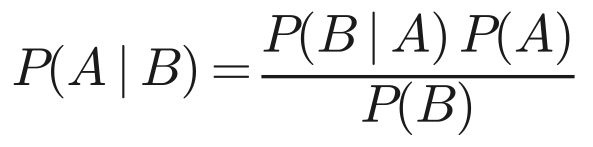
This is Bayes' Theorem. It's actually one of the most humane ideas ever written down, because it's a formal description of how to change your mind well. It says
Your new belief should depend on what you believed before and how strongly the new evidence points one way.
This equation has three moving parts:
The prior: what you believed before the new thing happened. (How likely was "my friend hates me" before today?)
The evidence: how strongly does what just happened support your scary theory compared to all the more ordinary explanations?
The posterior: your updated belief after you weigh the new evidence against what you already knew.
A simpler way to think about it: the posterior is the amount of evidence that genuinely supports your conclusion divided by all the possible explanations for what you’re seeing.
That last part is where clear thinking either happens or collapses. Most of us skip that step entirely. We see something painful, confusing, or emotionally charged and immediately treat our first interpretation as reality. And that’s where so many terrible conclusions come from.
The Error That Breaks Human Reasoning
Let me show you the most famous example in all of probability theory, because once it clicks, you start seeing it everywhere.
Imagine there’s a disease that affects 1 in every 100 people. There is also a test for it, and it’s objectively a very good test. If someone actually has the disease, the test catches it 99% of the time. And if someone is healthy, it only falsely flags them about 5% of the time.
You take this test and it comes back positive. How worried should you be?
Most people instinctively answer something like: “Very. The test is 99% accurate, so I probably have it.” Even doctors get this wrong in studies. The conclusion feels immediate and obvious. Positive result. Highly accurate test. End of story.
But that’s not how probability works. Let’s slow down and do the math again.
Take 1,000 people:
About 10 of them actually have the disease.
The test catches almost all of them. So you get roughly 10 true positives.
Now look at the healthy group:
About 990 people are completely fine.
But 5% of healthy people still test positive by mistake.
5% of 990 is about 50.
So now you have around 60 positive results total but only 10 of those people are actually sick. Meaning: after testing positive, your real probability of having the disease is closer to 17%, not 99%.

Sit with that for a second. A positive result on a genuinely excellent test, and you’re still probably fine. The test didn't fail. The test worked exactly as designed. The thing your intuition ignored was the prior, that is the disease was rare to begin with. That fact mattered more than the vividness of the positive result.
And, that's the cardinal sin of human reasoning. It has a name: base rate neglect.
We fixate on the vivid new evidence (positive test! unanswered text! one bad date!) and we forget how unlikely the scary thing was in the first place. We treat one loud signal as the whole story, when it's actually a thin slice of a much larger picture.
The internet is, more or less, a base-rate-neglect machine. But we will get to that point later.
Now let’s go back to your friend and the unanswered text.
What’s the prior here? This is someone who has known you for years. Someone you’ve shared thousands of conversations, jokes, memories, and ordinary moments with. Across all that history, how many times has “they didn’t reply for a few hours” actually meant “they secretly hate me now”?
Probably close to zero. That matters, a lot. Because the base rate of “this person suddenly hates me” is incredibly low before the delayed reply even enters the picture.
Now look at the evidence itself: one unanswered text. And this is where Bayesian thinking forces you to ask the question your anxious brain wants to avoid:
What else could produce the exact same signal?
Maybe they’re busy. Maybe they’re exhausted. Maybe they saw it and forgot to respond. Maybe they’re driving. Maybe they’re overwhelmed. Maybe their phone died. Maybe they’re having a bad day that has absolutely nothing to do with you. Maybe they’re asleep.
A delayed reply is completely consistent with all of these explanations. In fact, it fits them far better than “this person secretly despises me.”
The unanswered text feels emotionally loud, but statistically it’s weak evidence. It’s the equivalent of a false positive on the medical test. Your brain sees the signal and immediately jumps to the most catastrophic interpretation while ignoring how rare that conclusion was to begin with.
Bayesian thinking is not telling you to suppress the feeling. The anxiety you feel is real. The dread you feel is real. Your nervous system is genuinely reacting to uncertainty and perceived social risk. But, what the Bayesian theorem is telling you is that the conclusion your mind arrived at is far stronger than the evidence supporting it.
And, that’s the power of Bayesian thinking. It asks you to calibrate your conclusions to the actual weight of the evidence. Most of our suffering lives in the gap between those two.
Why The Internet Hates Bayesian Thinking
Bayesian thinking, which means holding beliefs lightly, in proportion to evidence, and remaining willing to update them, is one of the most intelligent things a mind can do.
The algorithm does not reward careful thinking. It rewards people who sound completely certain. You might have already noticed that a careful, calibrated take almost never goes viral. The viral post is usually the one spoken with total conviction and emotional volume even when the evidence doesn’t justify it. Confidence drives engagement. Nuance gets scrolled past.
So the platforms silently selects people who perform certainty for an audience that rewards them for it. Changing your mind in public or changing your opinion based on latest evidence which should be seen as a sign of honesty and intelligence gets treated as weakness instead. We’ve built an attention economy that punishes the exact behavior that makes someone human, intelligent and trust worthy.
And it leaks into how we treat ourselves. We feel pressure to have a take, immediately, on everything to convert a thin sliver of evidence into a confident position before the timeline moves on. We've outsourced our priors to whoever yelled first. I have observed this pattern about myself several times.
Intelligent people are not the ones who cling most tightly to their opinions. They're the ones whose opinions move when the evidence does and stay put when it doesn't. That's not indecision. That's the entire skill. A belief was never supposed to be a flag you plant and defend to the death. It's a position you hold, honestly, until the evidence walks you somewhere else.
The Art of Leaving the Question Open
Here is the line worth remembering. "Most suffering comes from conclusions we reached too early."
Let us try to build the ability to leave a question open a little longer instead of rushing to the worst explanation possible. So much pain comes from treating incomplete evidence like a final verdict. Why should we let ourselves suffer over something that might not be true at all? :)
Sign up for free!
Monthly newsletter straight to your inbox — no spamming or marketing campaigns.